Water Scarcity: Fiction Becomes Fact
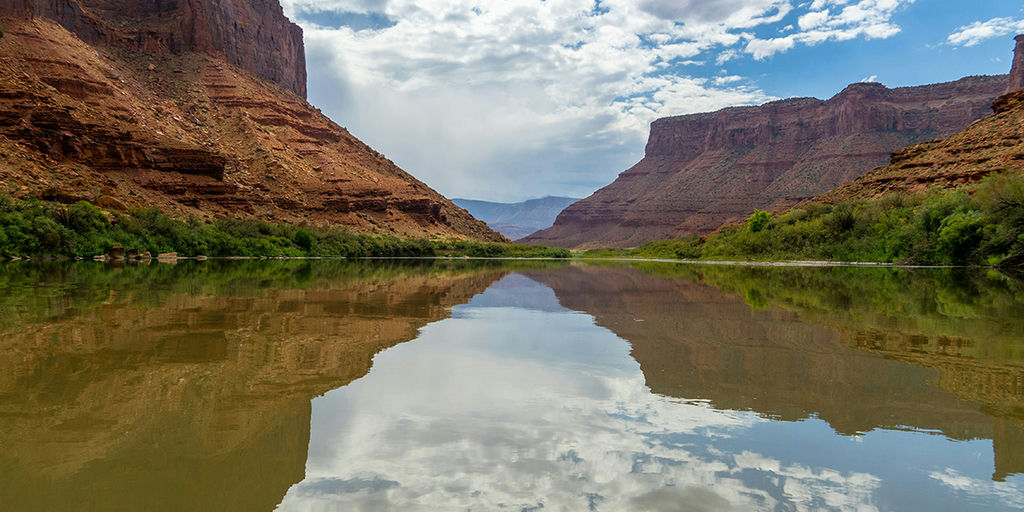
Photo by Mike Newbry on Unsplash
In the novel The Water Knife, a handful of states exploit complex legal (and also violent paramilitary) strategies to maintain control of the Colorado River’s crucial water supply.
In reality today, a handful of states are actually exploiting complex legal (but not yet paramilitary) strategies to keep as much of the river’s dwindling water resources in their hands as possible.
Paolo Bacigalupi, an award-winning author of novels that often center on environmental and climate themes, has seen his 2015 book become closer to reality over the last 11 years. He has strong feelings about the trend. But while Bacigalupi holds no trust in the political and corporate levers of power, he still expresses belief in the power of communal action.
“We see the federal government becoming more anemic, and we see political schisms between states becoming more pronounced. We see a rise in political violence. The U.S. as an entity seems to be weakening itself. Water is more scarce, and global temps are - as anticipated - rising,” Bacigalupi said. “We have increasing global conflicts and economic uncertainty. We have done nothing to address climate change impacts, or to mitigate them. Indeed, this administration seems hell-bent on accelerating global warming. I’ve always thought The Water Knife depicted the stupid, but also entirely avoidable future. Our current political climate shows that we aren’t just lazy and feckless, but also clownishly stupid and inept, if not flat-out suicidal.”
Rivers Running Dry
The Colorado River flows over 246,000 square miles in Wyoming, Colorado, Utah, New Mexico, Arizona, Nevada, and California, along with Mexico. In the United States alone, water from the river irrigates 5.5 million acres of land for agriculture and provides municipal and industrial water supplies for roughly 40 million people, the Congressional Research Service (CRS) said in a May 2026 report. The waterway supports endangered species and recreation, and its hydropower plants can generate in excess of 4,000 megawatts of electricity annually.
But the river is severely diminished. The Colorado River Basin’s snowmelt-fed yearly natural flows have dropped from an average of 14.6 million acre-feet from 1906 to 2024 to roughly 12.4 million acre-feet between 2000 and 2024, CRS reported. The years from 2000 to 2022 were comparable to the driest times in the river region in 1,200 years, the federal Bureau of Reclamation said. Consumption of Colorado River water generally outstrips flow each year, making storage crucial to balance that tendency - primarily through reservoirs created by Glen Canyon Dam on Lake Powell in Arizona and Utah in the river’s Upper Basin and Hoover Dam on Lake Mead in Nevada in the Lower Basin. But a regional drought that began in 2000 is also undermining those water storage supplies. Lake Mead water levels, for example, reached a record low of 1,040.3 feet above sea level in August 2026, Time magazine reported.
“Quite a few years ago I was at a water conference where [former Southern Nevada Water Authority general manager] Patricia Mulroy spoke, and she said that no one was doing enough or taking the issues of the river seriously enough, and she was right, and everyone in the room knew she was right, and the news since has proved her right,” said Bacigalupi. “So in a lot of ways, there’s not much point looking at the news, because the only news that would be interesting would be that we stopped being so predictably stupid about our predictable and avoidable problems.”
The Culprits
Drought and climate change are central to the river’s woes. Throughout the Colorado River Basin, precipitation has fallen by 7% since 1999, ScienceDaily reported in April of this year. Snow melts rapidly, and water that might have reached the river is lost to evaporation and plants. Dry soil can also soak up significant amounts of snowmelt that would also otherwise help replenish the river. “Climate change impacts, including warmer temperatures and altered precipitation patterns, may further increase the likelihood of prolonged dry conditions in the basin,” according to the CRS report.
In The Water Knife, which takes place in the near future, the situation has gone beyond dire for much of the region. The rich stay in luxurious “arcologies” with plenty of water in cities such as Las Vegas; most everyone else suffers. Phoenix has become nigh-unlivable and Arizona and Nevada are effectively at war. The book begins with a Nevada National Guard attack on an Arizona water treatment plant, during a brief window of opportunity amid a court case. Led by the titular water knife, a mercenary employed by a fictional version of the Southern Nevada Water Authority, the guard destroys the plant to protect “the private property rights of the citizens of the great state of Nevada.” The rest of the book follows the increasingly violent hunt around Phoenix for a previously secret document providing water rights in the region.
Water in the Courts
The Colorado River states today aren’t at war, and in fact have collaborated on water conservation. But to call them friendly on the matter of river resources would be a stretch. The 104-year-old Colorado River Compact apportions annual water allowances between the seven U.S. states and Mexico. Department of the Interior guidance from 2007 on water allotments during shortages, like those occurring now, is scheduled to expire at the end of 2026. A new federal plan establishes a decade-long structure for water usage, with possible updates every two years, Colorado Public Radio reported in August. Water access reductions fall hardest on the Lower Basin states of Arizona, California, and Nevada, each losing 1.25 million acre-feet annually in both of the next two years, according to the report. Legal responses are already underway - Nevada in August sued the Department of the Interior to block the federal plan, and more litigation is almost certain. Ultimately, the fight could reach the U.S. Supreme Court.
“I don’t have much faith in the court to make rational decisions about water management, nor to understand the complexities of the issues,” Bacigalupi said. “I could be wrong. There may be a new allocation at the end of it, but I doubt it will cause some grand re-thinking about how we use water, or more importantly, how we managed to dig ourselves into this hole, nor what we need to do to dig out of it.”
Rational approaches to providing water to the states must be predicated on need, not on want or on the seniority of water rights, he added. This is a solvable problem, but legal, political, economic, and social structures today make it difficult to focus on sustainability when it comes to water, according to Bacigalupi.
“The more we plan and build and invest in sustainability, and controlling climate change, and building resiliency at the group and community level where each dollar goes a lot further than having to buy an individual clearsac [a portable water filter from the novel], the better off we are,” he said. “It’s the cheapest, most rational future, and also the most selfish future that gives the most bang for the buck, and yet it also helps everyone the most. The future doesn’t have to be zero-sum, and it’s not going to get solved in a zero-sum way… When we go it alone, humans always fail. Our superpower is working together.”
Earth Hero also believes in the power of communal action to combat the climate crisis. You can find dozens of actions here to promote our Earth’s environment and reduce the impact of climate change.